Small Language Models vs LLMs: Key Differences
What are Small Language Models?
Large Language Models (LLMs), familiar through applications such as ChatGPT, often attract attention for their broad capabilities. Businesses are also exploring a more focused and often more practical option: Small Language Models (SLMs). These offer an accessible, efficient way to bring AI into core operations and tailor it to specific needs.
This article explains what SLMs are and how they differ from larger models. It explores their strategic advantages, practical applications and the considerations that help businesses put them to work.
Understanding Small Language Models
Small Language Models take a focused approach to AI, with streamlined architectures and performance optimized for specific tasks. Their parameter counts typically range from millions to a few billion, often staying below 10 billion.
Designed for efficiency, they can operate on devices with limited resources or in settings where connectivity, memory and electricity are constrained. SLMs are frequently fine-tuned on smaller datasets from a particular domain, creating specialized tools for specific uses.
Small Language Models vs LLMs
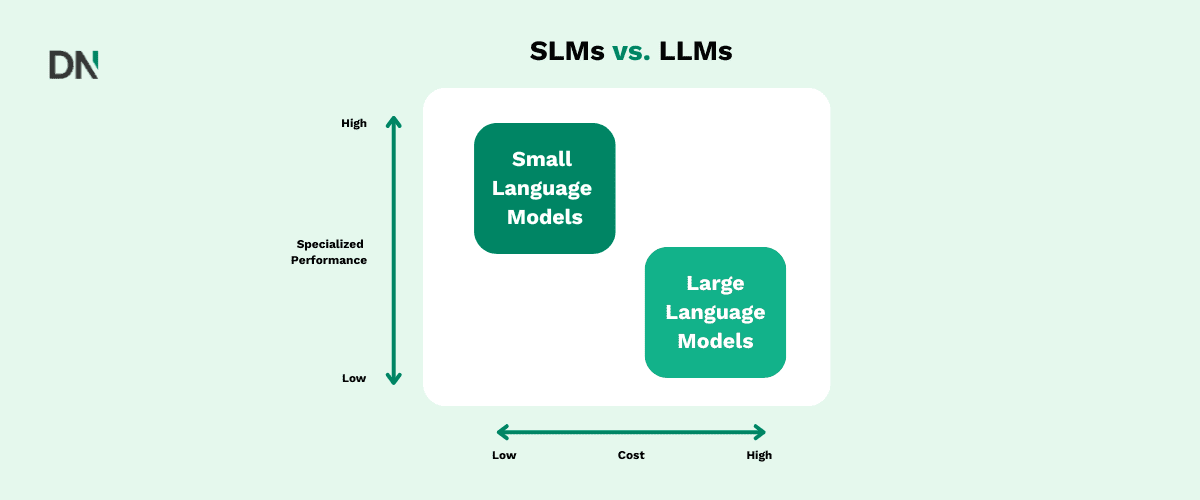
The differences between small and large language models shape both their capabilities and how businesses deploy them.
Size and model complexity
Large models such as GPT-4 have been estimated to contain as many as 1.76 trillion parameters. GPT-4 is also speculated to use a Mixture of Experts (MoE) architecture. By comparison, the open-source Mistral 7B has around 7.3 billion parameters.
Scale affects more than model size: it influences computing requirements and the range of tasks a model can handle.
MoE models are sparse, activating only a subset of their parameters for a given input. Even with an estimated total of 1.76 trillion parameters, a single forward pass would use far fewer. MoE architectures also support learning across a broad range of tasks, while dense variants are more rigid.
Training and resources
Training LLMs requires enormous datasets and computing capacity, often involving thousands of GPUs. This brings substantial infrastructure costs and continuing operational expenses.
SLMs require considerably less computing power, memory and storage, making them more affordable to train and maintain.
Versatility vs. specialization
LLMs are built for broad, general-purpose work, seeking to emulate human intelligence across many domains. Their strength is the variety of applications they can support.
SLMs focus on precision and efficiency within particular domains. This makes them useful for tasks where targeted accuracy matters most.
Inference speed
With fewer parameters, SLMs can generate responses faster and with lower latency. LLMs can respond more slowly, particularly when many users access them simultaneously.
Bias
SLMs carry a lower risk of bias because they are trained on smaller, domain-specific datasets. LLMs often draw on vast amounts of unfiltered internet data, where misrepresentation and under-representation can introduce bias.
Deployment
SLMs are easier to deploy on local machines, edge devices and mobile applications, often without substantial server hardware. LLMs typically require powerful cloud servers to operate.
Applications for Small Language Models
SLMs are finding practical uses in specialized industry settings.
Healthcare
SLMs can be customized to analyse medical text and provide real-time health monitoring and advice through smart wearables. Operating without a continuous cloud connection is important for maintaining patient privacy.
Finance
These models can analyse earnings calls and financial news to inform stock predictions. They can also assess loan documentation for credit scoring and identify changes in sentiment within market commentary.
Agriculture
SLMs are being developed to answer complex agronomic questions and help farmers make decisions in real time.
Legal
SLMs can examine contracts to identify and categorize clauses, flag potential risks, and extract important dates and financial terms for compliance tracking.
Marketing
SLMs can help produce marketing materials, including social media posts and product descriptions.
Your next step
Small Language Models offer an accessible, cost-effective route to integrating AI into core business operations. They bring precision to specific tasks, enhance data privacy and support real-time applications that can change how organizations operate and serve customers.
Successful implementation starts with understanding your business needs and choosing suitable tools. Whether you want to automate customer support, streamline data processing or develop on-device AI, SLMs offer a practical opportunity. Model selection, fine-tuning and deployment at scale can still be challenging.
DataNorth’s AI experts can help align your AI initiatives with business objectives and maximize your return on investment.
Originally published by Jorick van Weelie at DataNorth, updated 25 July 2025.
Comments
Join the discussionNo comments yet. Be the first to comment.