Vibe Coding vs Traditional Programming: Benefits and Risks
Software development is changing quickly. Work that once demanded extensive technical training and months of careful coding can now be approached through natural conversations with AI. Known as vibe coding, this shift is changing how applications are built, who can create them and how quickly ideas become working software.
Vibe coding is more than a development method. By opening software creation to more people, it could affect businesses of every size and industry. Understanding it helps companies keep pace with technology and guide clients through AI-assisted development.
Here, we explore what vibe coding means, its advantages and limitations, when it makes sense and how it compares with traditional programming.
What is vibe coding?
Definition and origins
Vibe coding uses AI to turn natural language prompts into functional applications instead of relying on manual programming. OpenAI co-founder and former Tesla AI leader Andrej Karpathy coined the term in February 2025.
Karpathy described it as “fully giving in to the vibes, embracing exponentials, and forgetting that the code even exists”. It replaces the precise, methodical emphasis of traditional programming with an intuitive, experimental approach powered by large language models (LLMs).
The idea follows Karpathy’s 2023 observation that “the hottest new programming language is English,” reflecting how AI has made natural language a practical programming interface. By March 2025, Merriam-Webster had listed vibe coding as a “slang & trending” term.
What are the key characteristics of vibe coding?
Four characteristics distinguish the approach:
- Natural language interface: users describe requirements and functionality in plain English instead of programming syntax. This opens development to non-technical users and can accelerate experienced developers’ work.
- AI-driven code generation: LLMs interpret descriptions and produce functional code, taking care of implementation details from basic algorithms to complex application structures without manual intervention.
- Iterative refinement: the emphasis is on “code first, refine later”. Users test generated solutions, then supply further prompts to improve functionality rather than aiming for perfect code immediately.
- Minimal code review: accepting generated code without comprehensive human review is a defining feature. As programmer Simon Willison noted, true vibe coding means using code “without full understanding” of how it works.
How vibe coding works
The process
Vibe coding moves from an idea to a working application through four steps.
Step 1: Choose an AI coding platform. Match the assistant to your technical requirements, performance needs and budget. Options include Replit, Cursor and cloud-based development environments.
Step 2: Define requirements. Describe the intended functionality clearly and specifically. Prompt quality directly influences output quality. Instead of “create an app,” try: “Create a startup name generator app with a text input for industry selection and a button that displays 10 creative company names when clicked”.
Step 3: Refine the code. Review the initial output, test the application and identify improvements. Use conversational feedback to fix issues, adjust functionality or add features.
Step 4: Review and deploy. Assess the refined code before deployment. Although less comprehensive than a traditional development review, this final check establishes whether the application meets basic functional requirements.
Popular tools and platforms
Several platforms support AI-assisted development, each with a different emphasis.
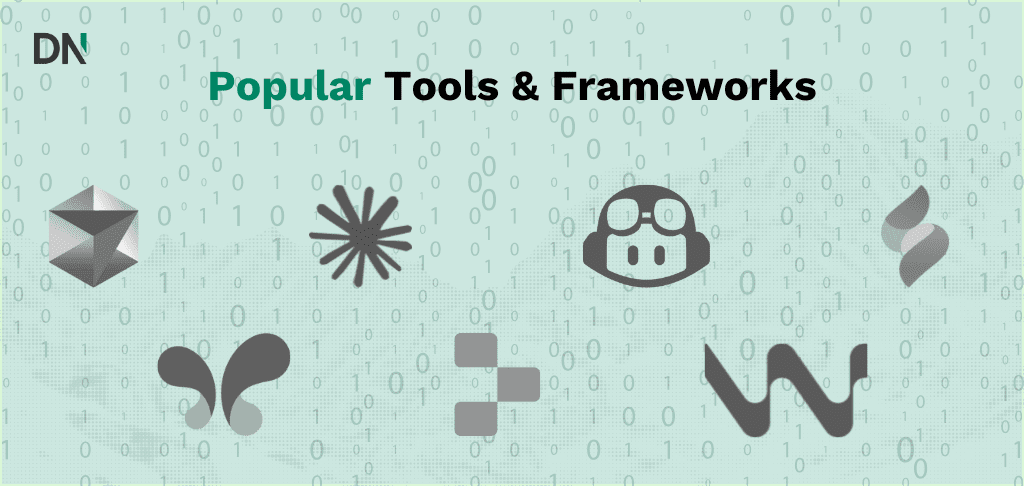
Google’s development platforms cover the path from idea to application. Google Cloud AI Studio offers a fast route, often starting from one prompt, with live previews and direct deployment to Cloud Run for public access.
Firebase Studio complements this with backend capabilities such as authentication and databases for production-ready applications. It creates detailed app blueprints for review before generating working prototypes.
Cursor is an AI-native editor built on VS Code. It integrates models such as Claude Sonnet for writing, editing and understanding code. Composer lets users delegate tasks to AI agents with context across multiple files.
GitHub Copilot led the cited survey, with 42% of engineers naming it their primary AI coding tool. Microsoft’s product supplies code suggestions within existing development workflows.
Replit offers a browser-based development environment with AI assistance through Ghostwriter. It supports rapid prototyping and collaboration without requiring a local setup.
Claude Code uses Anthropic’s models for code generation, debugging and natural language programming. It supports complex requirements and the creation of clean, documented code across multiple languages.
Windsurf is presented as a cloud-native IDE for vibe coding, combining real-time collaboration, AI assistance and deployment options. It pairs familiar development workflows with AI capabilities for rapid application creation and testing.
What are the benefits of vibe coding?
Speed and efficiency
Vibe coding can compress development from weeks or months into hours or days. The cited research reports up to 55% faster project completion compared with manual coding.
This is particularly valuable for prototypes and minimum viable products (MVPs). Businesses can validate ideas, test market demand and refine concepts without committing substantial development resources upfront. Moving from an idea to a working prototype within hours supports more agile strategies and faster responses to market opportunities.
Innovation and creativity
Automating routine coding gives developers more time for high-level problem-solving and creative design. Teams can concentrate on user experience, business logic and distinctive features instead of syntax and implementation details.
This supports what industry experts call a “problem-first approach”: prioritizing user needs over technical constraints. Teams can quickly test several possible solutions without the time normally needed to implement each manually.
The benefits also reach beyond developers. Non-technical team members can contribute directly, bringing domain knowledge and user insights that might otherwise be lost when business requirements are translated into code.
Accessibility and democratization
People without programming backgrounds can describe what they need and create functional applications. That substantially lowers the barrier to software development.
Domain experts can build solutions to industry-specific problems without depending entirely on technical intermediaries. Small businesses and startups can access custom software without the traditional cost of hiring specialized developers.
What are the risks and limitations of vibe coding?
Security vulnerabilities
AI-generated code can contain security flaws and outdated practices that expose production systems. The cited research reports basic vulnerabilities in 9 out of 10 AI-generated projects, which non-technical users may be unable to recognize or resolve.
Speed can amplify the problem when teams rush code into production without adequate review. Traditional development incorporates security into implementation; a vibe-coded “black box” can hide vulnerabilities until they are exploited.
Organizations need robust scanning processes and appropriate security review before deployment. DataNorth AI’s EU AI Act compliance service helps businesses address the regulatory and security implications of AI-assisted development.
Technical debt and maintainability
Generated solutions may depart from coding standards and architectural best practices, quickly accumulating technical debt. Applications “stitched together by vibes alone” can lack the structure and documentation required for long-term maintenance.
Debugging becomes harder when developers do not fully understand the code’s logic or implementation. That gap matters when updating applications, fixing bugs or integrating other systems. AI can also generate inconsistent coding patterns, adding to the maintenance burden.
Scaling introduces further challenges. Tools that work well for small or medium projects may struggle with distributed applications and complex architecture. Growing a vibe-coded application can therefore require substantial refactoring or a rebuild.
Quality and reliability concerns
AI-generated code can contain functional bugs, logic errors and performance problems that initial testing misses. Conversational refinement does not guarantee comprehensive quality assurance or systematic test coverage.
The cited study reports that 25% of developers estimate one in five AI-generated suggestions contains factual errors or misleading code. Such risks require additional quality controls in production or when applications handle sensitive data.
Models also have limitations with unfamiliar or complex problems. They handle standard algorithms and common functionality more readily than unique requirements or emerging technical challenges that demand original problem-solving.
Vibe coding vs traditional programming
These differences help businesses decide which development approach fits their needs.
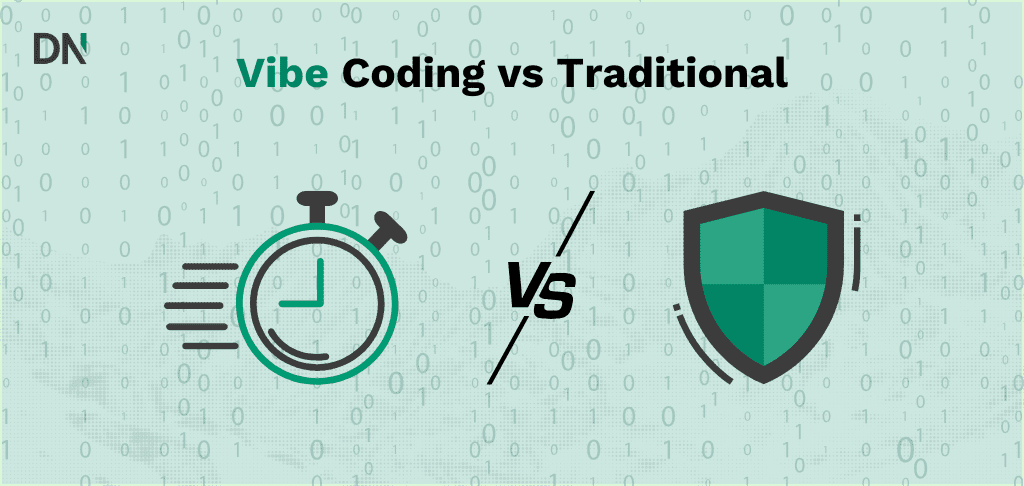
| Feature | Vibe coding | Traditional programming |
|---|---|---|
| Code creation | AI-generated from natural language prompts | Manual coding line by line |
| Developer role | Prompter, guide, tester, refiner | Architect, implementer, debugger |
| Technical expertise required | Lower (understanding of desired functionality) | Higher (knowledge of programming languages) |
| Primary input method | Natural language descriptions | Precise code syntax |
| Development speed | Faster, especially for prototyping | Generally slower, more methodical |
| Error handling | Refinement through conversational feedback | Manual debugging based on code comprehension |
| Learning curve | Lower barrier to entry | Often steep |
| Code maintainability | Depends on AI output quality and human review | Relies on code quality and developer skill |
| Scalability | Suitable for small to medium projects | Highly scalable for complex systems |
| Security control | Platform-managed with limited customization | Complete control over security measures |
| Best use cases | Rapid prototypes, MVPs, personal projects | Production systems, enterprise applications |
When to use vibe coding
Vibe coding is most useful when speed and accessibility matter more than code complexity or long-term maintenance.
Rapid prototypes and proofs of concept are its strongest use case. Working prototypes built in hours rather than weeks help validate business ideas and demonstrate functionality to stakeholders. This supports iterative design and faster market validation.
Internal tools and automation are another opportunity. Teams can build dashboards, data processing scripts and workflow tools without major development investment. The source describes these applications as typically having lower security and scalability requirements, making them suitable candidates.
Educational and experimental projects let teams explore new technology and ideas. The low entry barrier makes experiments possible that traditional development might not justify.
Startup MVPs have also embraced AI-assisted development. Reported data indicates that 25% of Y Combinator’s Winter 2025 startups built 95% of their codebase with AI assistance, illustrating its appeal for companies seeking rapid market entry.
When not to use vibe coding
Some applications need the precision and control of traditional programming.
Production systems handling sensitive data require comprehensive security review and custom protections that vibe coding typically cannot provide. Finance, healthcare and other regulated sectors need detailed security control.
Large, long-term applications benefit from deliberate architecture and structured development. Systems with many external integrations, demanding performance requirements or extensive customization exceed the capabilities of most vibe coding tools.
Mission-critical applications should avoid vibe coding when reliability is essential. Software whose failure could cause safety risks, financial losses or operational disruption needs comprehensive testing and validation.
Best practices for safe vibe coding
Security guidelines
Organizations need a clear security framework for AI-assisted development.
Require human review of all generated code before production deployment. Even when teams embrace the vibe coding philosophy, critical applications need security expertise to identify vulnerabilities introduced by AI.
Supplement that review with automated scanning. Static analysis security testing (SAST) and dynamic analysis security testing (DAST) can detect common vulnerability patterns and provide another layer of protection.
Define where vibe coding is appropriate and where traditional development is required. Clear boundaries ensure higher-risk systems receive suitable oversight.
Keep experimentation separate from production. Isolated environments prevent experimental applications from affecting live systems or sensitive data and reduce the risk of accidental breaches.
Quality assurance
Rapid development still requires systematic quality practices.
Combine vibe coding with established testing methods, including unit tests, integration tests and user acceptance testing. Quickly generated functional code still needs comprehensive validation.
Make sure team members understand critical components. Production work requires knowledge of at least the overall architecture and essential business logic, even if the underlying philosophy accepts code without full comprehension.
Document the prompts, intended functionality and changes made during refinement. These records support future maintenance and troubleshooting.
Apply version control and change management to generated code as you would to manually written code. That includes branching strategies, code reviews and deployment procedures.
The future of software development
Industry trends
AI-assisted coding is reshaping software development. The cited forecasts for 2030 predict that 25% of Y Combinator startups will generate most of their code with AI, routine tasks will become 80% automated and project completion will accelerate by up to 55%.
AI-generated pipelines and autonomous software development lifecycle loops are emerging as the next stage. These systems are expected to cover requirements, deployment and monitoring, allowing developers to concentrate on strategy, ethics and oversight.
Boundaries between low-code, no-code and professional programming are also narrowing. Platforms increasingly combine visual tools, natural language prompts and traditional code within interfaces that accommodate different skills and working methods.
Enterprise adoption is growing too. The cited 2025 reporting puts agentic AI usage at 82% of companies for software development tasks, compared with 50% in December 2024, pointing to a substantial change in development practices.
Impact on developers
Developers’ roles are shifting from implementing every line to coordinating AI and designing systems. Defining requirements, reviewing generated output and maintaining security and quality standards become increasingly central.
Prompt engineering, AI tool management and solution architecture are becoming more important skills. Programming knowledge remains valuable, while effective collaboration with AI increasingly matters for career progression.
Hiring practices reflect that shift. Companies including Visa, DoorDash and Roblox have included “AI coding fluency” in job descriptions and specified AI use for 50% or more of engineers’ workflows.
Development environments are also becoming multimodal, combining voice, visual and text interfaces. These advances promise greater accessibility and more intuitive workflows while improving productivity for experienced developers.
Getting started with vibe coding
Implementation steps
A structured rollout helps organizations explore the approach.
- Begin with low-risk experiments. Internal tools, prototypes and proofs of concept help teams understand the tools’ strengths and limitations while limiting potential business impact.
- Choose tools around your team and projects. Consider skill levels, requirements and budgets. The cited adoption figures put GitHub Copilot at 42%, while Cursor and Replit offer different advantages for particular uses.
- Set security and quality rules before expanding. Define review processes, scanning requirements and documentation standards that fit your risk tolerance and compliance obligations.
- Train the team. Cover prompt engineering, tool usage and quality assurance. Teams need to communicate effectively with AI and evaluate its output.
- Expand gradually using evidence. Track development speed, code quality and security outcomes, then use those results and lessons from initial projects to guide wider adoption.
Conclusion
Vibe coding is changing software development by making application creation more accessible and accelerating experimentation. Prototypes, internal tools and MVPs can help businesses validate ideas and respond to opportunities faster.
Those benefits come with security, quality and maintenance challenges. Organizations that combine appropriate guardrails, training and expert guidance can gain advantages while avoiding common mistakes.
The likely direction is a hybrid approach: the speed and accessibility of vibe coding alongside traditional programming’s precision and control. Understanding when to use each supports sustainable growth and innovation.
DataNorth AI helps organizations make this transition through expertise, training and strategic guidance, while maintaining risk management and quality standards. Explore our Vibe Coding Workshop to equip your team with the tools and guidelines it needs.
The shift is already underway. The challenge is how quickly and effectively your organization can adapt.
Originally published by Jorick van Weelie at DataNorth, updated 17 December 2025.
Comments
Join the discussionNo comments yet. Be the first to comment.