Synthetic Data Generation: When to Use It, How It Works, and Which Platform to Choose
Synthetic data is artificially created by algorithms rather than captured from real events or people. Gartner forecast that 75% of businesses would use generative AI to create synthetic customer data by 2026, compared with fewer than 5% in 2023. Generative models learn the distributions, relationships, and structure of source datasets, then produce new records intended to retain their usefulness without exposing personally identifiable information (PII).
Adoption is driven by a conflict between AI's demand for large training datasets and privacy obligations under regulations such as the GDPR and EU AI Act. Synthetic data can overcome limitations of data masking, shorten development timelines, and reproduce uncommon edge cases that real datasets rarely capture.
When to use synthetic data
Whether synthetic data is preferable to real data depends on privacy requirements, access to usable records, and the level of control needed for experiments.
Privacy and regulatory compliance
Sensitive production datasets may be unavailable for software testing or model training. Whereas anonymized or pseudonymized records can sometimes be reidentified through linkage attacks, well-generated synthetic records have no direct one-to-one correspondence with actual people. This is particularly valuable in healthcare and financial services, where information sharing is restricted. A privacy assessment can help determine whether synthesis appropriately reduces those risks.
Data scarcity and edge case simulation
Real-world machine learning datasets often contain far more common outcomes than rare ones. Fraud detection illustrates the problem: legitimate payments vastly outnumber fraudulent transactions. Engineers can generate large volumes of synthetic examples to help models learn patterns they would otherwise encounter infrequently.
Similarly, autonomous systems, including self-driving cars, can be tested against unusual or hazardous road situations through simulation rather than relying solely on costly or dangerous physical trials.
Rapid prototyping and internal sharing
Security approvals can delay access to enterprise production data for weeks or months. Synthetic datasets can be shared among teams with fewer administrative barriers, allowing development and prototyping to begin before permission to use live records is granted.
How synthetic data is generated
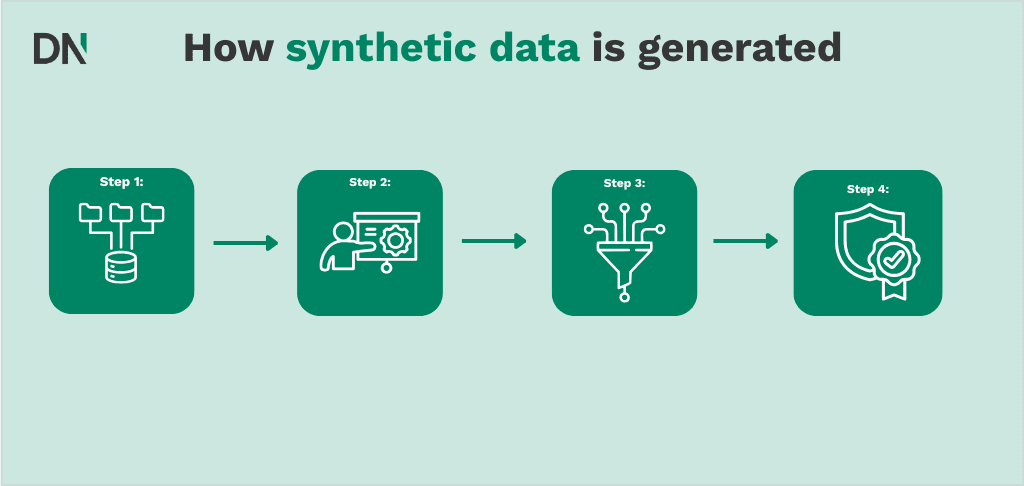
Creating synthetic data involves analyzing source information, fitting a generative model, producing new records, and checking that the results remain useful.
Step 1: Data ingestion and analysis
A seed dataset provides the starting point. The algorithm examines its metadata, schema, distributions, and relationships across categorical, numerical, and time-series variables. In retail data, for example, it needs to learn the logical timing between a purchase date and its delivery date.
Step 2: Training the generative model
The modeling technique depends on the kind of data involved:
- Generative Adversarial Networks (GANs): A generator and a discriminator compete, progressively improving the realism of the synthesized data. The European Data Protection Supervisor discusses this approach.
- Variational Autoencoders (VAEs): These compress original records into a lower-dimensional representation and reconstruct them to create similar new samples.
- Diffusion models: Often applied to images and other unstructured inputs, these learn to reverse a process that adds noise to data.
Step 3: Synthesis and privacy filtering
After training, the model generates new samples. Differential privacy or other filtering approaches can reduce the risk that it has memorized original rows through overfitting and exposes sensitive information. An AI workshop can help teams understand how to configure these methods.
Step 4: Quality assurance and utility testing
The output is statistically compared with the original dataset. Automated checks evaluate utility, including whether a machine learning model trained on synthetic records performs comparably to one trained on real data.
Comparing synthetic data platforms
In 2026, synthetic data tools differ primarily by the formats they support, from structured databases to unstructured media, and by how they integrate into existing workflows.
| Platform | Specialization | Key features | Target use case |
|---|---|---|---|
| Gretel.ai | Multimodal: text, tabular, relational | Developer APIs, privacy-as-code, support for complex relational databases | DevOps, AI training, data sharing |
| Mostly.ai | Structured/tabular data | High-fidelity generation of behavioral and time-series data | Banking, insurance, telecommunications |
| Tonic.ai | Database synthesis | Subsetting, de-identification, synthesis across linked databases | Software testing and QA environments |
| NVIDIA NeMo | Agentic AI and unstructured data | Text-based synthetic datasets for LLMs and autonomous agents | Robotics, conversational AI, research |
| Synthesis AI | Computer vision | Photorealistic human images and 3D environments | Biometrics, security, virtual reality |
Selecting a platform requires assessing which option best preserves utility for the distributions in your own dataset.
Limitations and technical considerations
Synthetic datasets are useful, but they cannot replace real-world information in every situation.
- Model collapse: Repeatedly training AI on synthetic outputs without new real examples can erode distribution tails, reducing variety and accuracy. This risk has been discussed in synthetic data workflows.
- Bias amplification: A generator can reproduce or intensify biases present in its seed data, such as unfair patterns involving gender or race in hiring. Careful audits remain essential.
- Complex outliers: Generative methods may discard rare but important records as noise. In medical diagnosis, those unusual examples can be particularly consequential.
An AI implementation partner can help structure workflows combining real and synthetic records to address these limitations.
Conclusion
In 2026, synthetic data has become an important part of enterprise AI rather than only a specialized privacy technique. It can ease restrictions on data access, supply rare scenarios, and speed up development at scale. Its value, however, depends on validating model utility and carefully controlling bias.
Frequently Asked Questions
Is synthetic data personal data under the GDPR?
Generally not, provided it cannot be related to an identified or identifiable individual or traced to an original subject. Such information is treated as anonymous and falls outside the GDPR. However, generating it from personal records still involves processing that must comply with privacy law. See the European Data Protection Supervisor's explanation.
Can synthetic data train large language models (LLMs)?
Yes. It is used to fine-tune LLMs for specialized domains where real conversation samples are limited or sensitive. This is one component of building a custom enterprise AI solution.
How is synthetic data quality measured?
Two measures matter: utility and privacy. Utility tests compare distributions or evaluate whether a model trained on synthetic data performs similarly on a real test set. Privacy assessments examine the risk of reidentifying individuals.
How does synthetic data differ from data masking?
Masking removes or obscures fields in existing records. Synthesis creates entirely new records instead. Compared with conventional masking, it can offer stronger privacy protection while better retaining complex statistical relationships.
Comments
Join the discussionNo comments yet. Be the first to comment.