Vectorization in AI
Methods, Embeddings and Applications
Vectorization is a foundation of modern AI, allowing machines to process text, images, audio and video. It converts complex information into arrays of numbers that systems can compare and work with efficiently. Think of it as translating human information into a mathematical language.
It also underpins familiar experiences: Netflix suggesting a show, Google interpreting a search without an exact keyword match, or your phone recognizing faces in photos. This article explores what vectorization means, its different forms and its role in future AI development.
What is vectorization?
Vectorization turns data into numerical representations called vectors. Instead of processing raw text, images or audio directly, AI systems work with lists of numbers. Each item becomes a point in a multidimensional space, where similar items can cluster together.
Imagine a library arranged by more than author or title. Vectorization creates a map in which books about related subjects sit close together, even when their authors and wording differ. Calculating distances and similarities between these representations helps AI identify patterns, make predictions and recognize relationships.
Meaning is central to this approach. The words “happy” and “joyful” can sit near each other because they convey similar ideas. Likewise, images of cats can cluster together despite differences in appearance.
Different types of vectorization
Methods differ in what they represent and which information they retain. Each has strengths and limitations, making the choice dependent on the application.
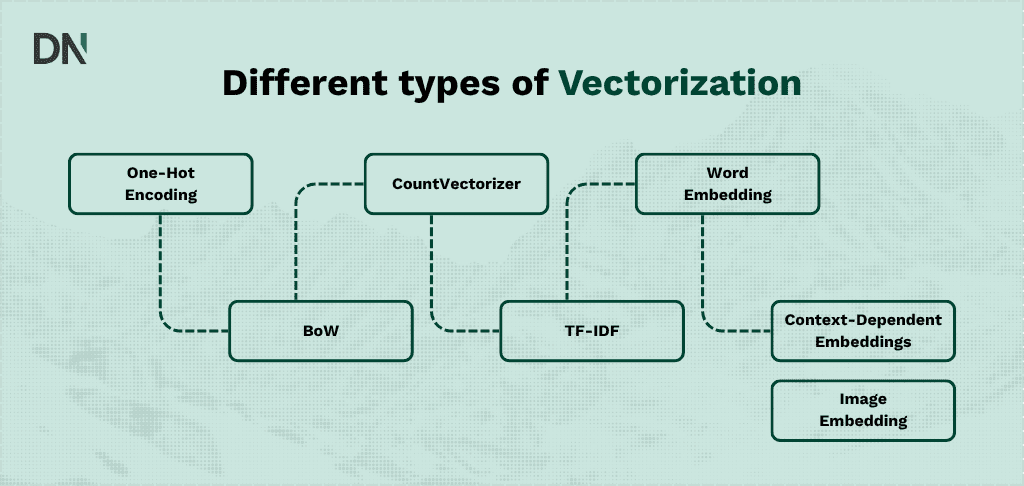
One-hot encoding
One-hot encoding is the simplest approach. Each word receives a sparse binary vector containing one “1”, with every other position set to “0”. For a vocabulary containing “cat,” “dog,” and “bird,” each word has its own vector.
[The original numerical vectors are missing from the source article.]
The method is straightforward to implement and suits small datasets or simple applications. However, vector length increases with vocabulary size. A dictionary containing tens of thousands of words produces enormous, mostly empty vectors. It also treats words independently, capturing no semantic relationships.
Bag of Words (BoW)
Bag of Words represents documents through word frequencies. Each vector position corresponds to a vocabulary word and records how often it appears, rather than simply using a binary value.
Consider three documents: “the cat in the hat,” “the cat sat on the mat,” and “the dog chased the ball.” BoW produces a count vector for each. Positions follow the vocabulary order, alphabetically beginning with “ball,” “cat,” “chased,” “dog,” “hat,” and so on.
[The numerical vector for document 1 is missing from the source article.]
BoW captures frequency, but ignores word order and semantic relationships. It represents “dog chased cat” and “cat chased dog” identically, losing an important difference in meaning.
Count vectorization and hashing vectorization
CountVectorizer implements the Bag of Words approach as a standardized tool. HashingVectorizer works similarly but uses a hash function rather than storing a vocabulary. This reduces memory requirements for very large datasets.
The trade-off is that a vector position cannot be converted back into its original word, which matters for keyword extraction. Different words may also map to the same position, causing “hash collisions” that distort the representation. HashingVectorizer is particularly useful for streaming data and datasets that cannot fit in memory.
Term Frequency-Inverse Document Frequency (TF-IDF)
TF-IDF considers both a word’s frequency within a document and how common it is across the collection. Words used frequently in one document but rarely elsewhere receive higher weights. Common terms such as “the” and “and” receive less weight than domain-specific vocabulary.
For sports documents, “basketball” would score highly in basketball articles and lower in general material. TF-IDF captures word importance more effectively than simple counts, but still does not understand semantic meaning or relationships between words.
Word embeddings
Word embeddings move beyond frequency-based representations. They replace large, sparse vectors with dense vectors of fewer dimensions, capturing latent features and semantic information.
Word2Vec, introduced by Google researchers in 2013, learns representations that place semantically related words close together. Its well-known analogy, king minus man plus woman equals queen, illustrates how vector arithmetic can reflect relationships between concepts.
One-hot encoding keeps categories independent and equally distant. Embeddings instead place “cat” and “dog” relatively close because both are animals, while “cat” and “car” are farther apart.
Context-dependent embeddings
Word2Vec assigns a word the same vector regardless of its surroundings. Later approaches such as BERT produce different representations depending on context. BERT reads bidirectionally, using information on both sides of a word.
That gives “bank” different embeddings in “financial bank” and “river bank”.
Modern language models extend these capabilities. GPT-4 and ChatGPT use advanced transformer architectures to capture nuanced semantic relationships. OpenAI also provides dedicated embedding models, including text-embedding-3-small and text-embedding-3-large, for different applications.
The small model produces 1,536-dimensional vectors suitable for most uses. The large model produces richer, 3,072-dimensional embeddings for tasks requiring maximum semantic precision.
These models handle context, multiple languages and subtle differences in meaning that earlier approaches missed. Larger training datasets and more sophisticated architectures than BERT help them represent relationships across domains and languages.
High-quality embeddings demand more computing resources for training and inference than simpler methods. They nevertheless represent the leading approach described in the source for semantic representation, supporting search, recommendations, question answering and content generation across modern AI systems.
Image embeddings
Vectorization also applies to images. Image embeddings compress meaningful visual features into numerical representations. Convolutional neural networks extract features at different levels, from edges to recognizable objects.
A cat’s representation might activate dimensions associated with “furry,” “four-legged,” “pointed ears,” and “feline”. This helps systems recognize cats that differ from training examples and supports image search, object recognition and visual similarity applications.
Measuring similarity between vectors
Once information is represented numerically, systems need ways to compare it. Cosine similarity measures the angle between vectors. Scores range from -1 for opposite directions to 1 for the same direction. Its emphasis on direction rather than length makes it useful for comparing meaning across documents of different sizes.
Imagine two arrows pointing almost the same way. Their directions are similar even if one is longer. In semantic search, this allows a short document and a long one about the same subject to be treated as similar.
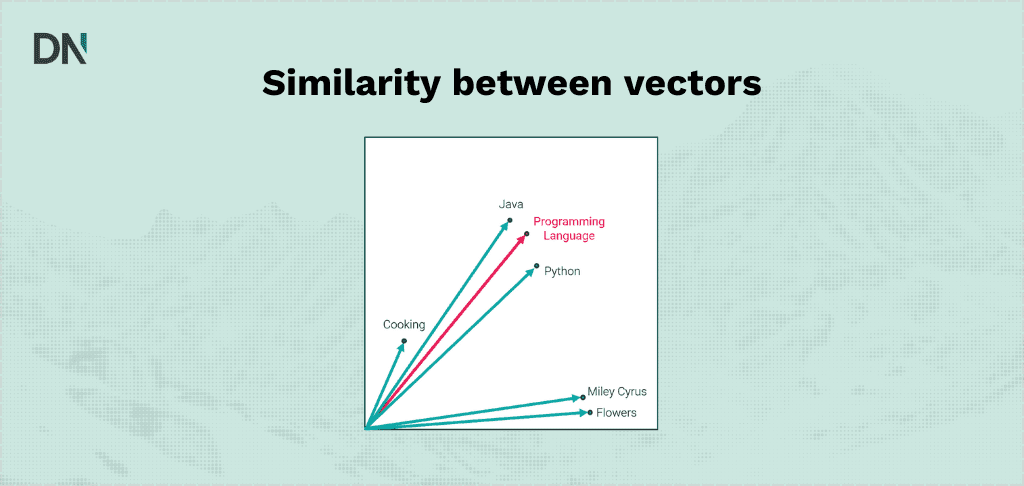
Other measures, such as Euclidean distance, calculate the straight-line distance between vectors. Each has suitable applications, while cosine similarity is widely used for text and semantic comparisons.
How is vectorization being used?
Many AI platforms depend on vectorization. Their everyday applications show why it has become such an important part of modern systems.
Vectorization in ChatGPT and language models
ChatGPT uses vector representations to interpret and generate text. A question is converted into high-dimensional vectors that capture semantic information, helping the system follow context, recognize related concepts and produce responses aligned with the user’s intent.
Mapping words and sentences into a high-dimensional space expresses semantic relationships mathematically. This helps explain its ability to relate “physician” to “doctor” or recognize a follow-up question expressed in different words.
Embeddings connect raw text with the language processing that makes conversational AI possible.
Vectorization in Claude and retrieval augmented generation
Claude uses vectorization in Retrieval Augmented Generation (RAG) systems. Documents are converted into embeddings and stored in a vector database. A question is also represented as a vector, allowing the system to retrieve document chunks with similar meanings.
Anthropic’s “Contextual Retrieval” methods improve the retrieval of relevant information. The source reports a 49% reduction in failed retrievals compared with traditional methods. Contextual embeddings preserve meaning when a chunk is separated from the surrounding document, improving retrieval accuracy and the usefulness of responses.
Vectorization in Google Search and semantic understanding
Google Search uses vector embeddings for semantic search. Beyond matching keywords, it represents queries numerically and compares them with representations of billions of web pages, helping return results that match intent rather than exact wording.
Vertex AI Vector Search handles large datasets using research that also powers products such as YouTube and Google Play. Putting queries and documents in a shared vector space makes relevant matches possible even when their words differ.
Vectorization in Spotify’s music recommendations
Spotify uses embeddings and matrix factorization in its recommendation engine. User vectors represent musical tastes, while song vectors represent their characteristics. Songs often played together or added to similar playlists receive similar representations.
User-song interactions are decomposed into lower-dimensional vectors, forming a latent “taste space”. Similarity between a user and a song helps predict enjoyment, discover less familiar music and create personalized playlists such as Discover Weekly.
Vectorization in Netflix’s content recommendations
Netflix uses embeddings within its recommendation system. Its “Foundation Model for Personalized Recommendation” draws on large-scale data to represent users and content, capturing viewing history, preferences, content features and context such as time of day.
These embeddings support downstream applications ranging from direct prediction to recommendations fine-tuned for particular contexts. The source reports that recommendations account for over 80% of Netflix viewing. Learning continually from interactions and updating representations makes the experience increasingly personalized.
Vector databases and efficient storage
Billions of vectors require specialized storage and retrieval. Databases such as Pinecone and Weaviate index embeddings so applications can find similar items in milliseconds without comparing every stored vector.
Traditional databases are strong at exact matches; vector databases focus on similarity. Approximate nearest neighbor algorithms exchange a small amount of accuracy for much faster searches. Rather than checking a million vectors, an algorithm might examine 10,000 selected candidates and still find the right answer 95% of the time.
That efficiency supports real-time document searches, product similarity across large catalogs and chatbots that need immediate access to relevant information. Vector databases supply the speed and scale these applications demand.
The future of vectorization
Embedding models continue improving their representation of meaning. Multimodal systems can place text, images and audio in a shared vector space, supporting searches for images using text or music using a hummed melody.
Efficiency is improving too. Compression lowers storage costs while preserving quality, faster algorithms search massive datasets in real time, and specialized hardware makes complex vector operations practical on edge devices.
Vectorization will remain fundamental as AI advances. It connects human information with machine processing, helping systems work with meaning rather than symbols alone. Understanding it is essential when building effective search, recommendation and conversational applications.
Vectorization at and by DataNorth AI
DataNorth AI uses vectorization to develop intelligent solutions across industries. Our AI Strategy consulting helps organizations identify opportunities for advanced retrieval. Our Knowledge Base solution uses vector-based document understanding to process uploaded documents through embeddings and turn unstructured information into actionable insights.
We can tailor this approach through Custom AI Solutions, whether you need better search, recommendations or intelligent document management. Contact DataNorth AI experts to explore what vectorization could do for your business.
Originally published by Jorick van Weelie at DataNorth.
Comments
Join the discussionNo comments yet. Be the first to comment.