Vector Databases in 2026: Pinecone, Weaviate, Qdrant, pgvector, and Milvus Compared
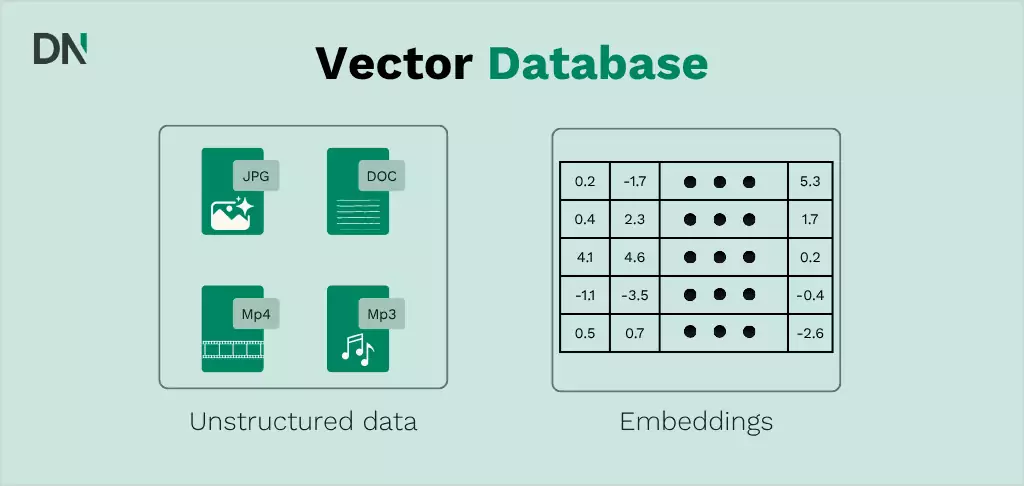
A vector database is a system built to store, index, and retrieve high-dimensional representations known as vector embeddings. In 2026, it provides a vital memory layer for large language models (LLMs) and Retrieval-Augmented Generation (RAG).
By representing text, images, and audio as numerical arrays, these systems search for semantic meaning and context rather than relying only on matching keywords.
As enterprise AI moves from pilot projects into production, database selection increasingly depends on scalability, secure multi-tenancy, and hybrid search.
Where vector databases fit in an AI architecture
A vector database places data within a continuous geometric space. At search time, it measures the distance between a query vector and stored vectors to retrieve related information. This enables organizations to bring proprietary data into generative AI systems.
These databases are part of a broader data pipeline, not isolated utilities. Their design affects retrieval latency, serving costs, and the accuracy of generated answers.
One notable shift in 2026 is the move away from specialized databases where existing infrastructure can do the job. For many RAG workloads below approximately 5 to 50 million vectors, pgvector running inside PostgreSQL provides adequate performance without another system to maintain. It deserves consideration before adopting a dedicated service.
Pinecone: Managed, serverless vector search
Pinecone appeals to enterprises that want managed scalability without significant operational work. Its serverless design separates compute and storage, so usage-based costs track the data accessed through queries.
Architecture and performance
Pinecone Serverless keeps its main vector index in inexpensive object storage, such as S3, and brings required segments into a faster cache during retrieval. According to Pinecone's estimates, this can reduce overhead by as much as 50 times compared with older pod-based architectures.
Technical capabilities
- Indexing: Proprietary graph-based indexing built for low-latency search.
- Scale: Billions of vectors without manually managing shards.
- Metadata filters: Real-time filtering on attributes such as department, region, or date.
- Hybrid search: Combines dense vectors with Pinecone's proprietary sparse encodings. Unlike open-source systems using standard BM25, this provides hybrid retrieval through Pinecone's own approach.
- Pinecone Assistant: Generally available since January 2025, it exposes chunking, embeddings, search, reranking, and answer generation through one endpoint, extending the product beyond storage into managed RAG.
Enterprise deployment and sovereignty
Pinecone is suited to applications such as worldwide customer support, where reliability and rapid scaling matter but a dedicated DevOps team may be unavailable. The service lists SOC 2 Type II, ISO 27001, GDPR alignment, and HIPAA attestation, making it attractive to regulated organizations.
Its Bring Your Own Cloud (BYOC) offering became generally available in 2024. Running clusters within the customer's AWS, Azure, or GCP account provides stronger data isolation than the earlier public-cloud-only model, changing how organizations with strict residency requirements can assess Pinecone.
Weaviate: Open-source flexibility and hybrid retrieval
Weaviate focuses on adaptable data models and advanced hybrid search. Its distinguishing feature in 2026 is the mature combination of semantic vector retrieval and traditional keyword search.
Architecture and features
Weaviate organizes data using a class-based model familiar to developers working with object-oriented programming. Modules connect it to numerous embedding models.
Main performance features
- Hybrid ranking: Blends keyword and vector results through Reciprocal Rank Fusion (RRF) and Relative Score Fusion (RSF). RSF retains differences in the original scores, not only their positions. BlockMax WAND became generally available in 2025, reportedly making keyword retrieval about 10 times faster than earlier versions.
- Multiple vectors: MUVERA encoding supports documents with several vector representations, useful for complex document formats.
- Knowledge graphs: Weaviate is described in the source as the only major vector database natively joining vector search with a knowledge graph layer, allowing structured entity relationships and semantic similarity to work together.
- Tenant separation: Supports isolating customers and users inside one cluster, important for SaaS applications.
- Deployment options: Runs on-premises, in private clouds, or through Weaviate Cloud Services (WCS).
Industry applications
Weaviate's customizable schemas and open-source design help teams with complex data and strict sovereignty requirements. It is particularly relevant when users need documents that are semantically related and contain an exact keyword, legal reference, or statute. The article identifies Weaviate as the most mature hybrid-search option in 2026.
Qdrant: Fast retrieval with efficient resource usage
Built in Rust, Qdrant prioritizes memory safety, performance, and low resource consumption. These characteristics appeal to enterprises handling frequent queries, edge deployments, and real-time data.
Quantization and efficiency
Scalar quantization converts 32-bit floating-point vectors into 8-bit integer representations. The source reports memory savings of up to four times while retaining search accuracy above 99%.
Technical characteristics
- Throughput: The capacity to serve tens of thousands of queries per second (QPS) on standard hardware, as described in the source.
- Interfaces: Native REST and gRPC APIs support integration with different technology stacks.
- HNSW and ACORN: An optimized Hierarchical Navigable Small World index supports fast approximate nearest-neighbor search. ACORN, introduced in 2025, improves performance when metadata filters are restrictive.
- Hybrid retrieval: Named vectors have supported dense HNSW and sparse inverted indexes in one collection since v1.9. Server-side inverse document frequency (IDF) computation followed in v1.15.2, strengthening Qdrant's hybrid-search capabilities.
Real-time scenarios
Fraud monitoring and recommendations for high-traffic e-commerce platforms are examples requiring fast ingestion and retrieval. Qdrant's ratio of performance to infrastructure cost also makes it suitable for technical AI demonstrations.
pgvector: Extend the PostgreSQL you already use
Rather than operating as a separate database, pgvector adds vector storage and similarity queries to PostgreSQL. By 2026, it has become a realistic choice for many production RAG applications.
For moderate data volumes, keeping vectors in an existing PostgreSQL deployment avoids another infrastructure layer. Benchmarks cited by the source describe HNSW queries below 20 milliseconds across one million vectors at over 95% recall; pgvectorscale can extend competitive performance to 50 million vectors and above.
Advantages
- Existing infrastructure: Teams already using PostgreSQL need relatively little additional setup.
- Standard SQL: Applications can query vector similarity together with relational records.
- Structured filtering: Queries can combine semantic search with categories, dates, and user IDs through SQL.
However, pgvector is not designed as the first choice for billions of vectors or the most demanding high-QPS, low-latency workloads. Specialized systems such as Pinecone and Qdrant can provide stronger indexing and performance there. For many teams, beginning with pgvector and migrating when necessary is the practical default.
Milvus: Built for hundreds of millions or billions of vectors
Milvus is an open-source database designed for very large search collections. It is used in production at hundreds of millions to billions of vectors, including by search providers, e-commerce companies, and genomics researchers.
Milvus 2.6 reached general availability on Zilliz Cloud in early 2026. It introduced hot/cold data tiering to reduce archival costs and advanced the platform toward a broader retrieval engine. GPU-assisted indexing is supported natively.
That capability brings more infrastructure to operate. A production installation includes Kafka, MinIO, etcd, and Milvus coordination services. Kubernetes operators reduce some of the management burden, but Milvus still has more moving parts than Qdrant or Pinecone. Unless an organization expects hundreds of millions of vectors or needs its particular full-text hybrid-search performance, the additional complexity may not be worthwhile.
Comparing the five vector database options
| Feature | Pinecone | Weaviate | Qdrant | pgvector | Milvus |
|---|---|---|---|---|---|
| Model type | Fully managed (SaaS) | Open-source / Cloud | Open-source / Cloud | Open-source extension | Open-source / Cloud |
| Language | Go (Proprietary) | Go | Rust | C | Go / C++ |
| Primary strength | Zero-ops serverless | Hybrid search and schema | Performance and filtering | Simplicity for existing Postgres users | Billion-scale deployments |
| Indexing | Proprietary graph | HNSW + Inverted Index | HNSW + Quantization | HNSW / IVFFlat | HNSW, IVF, DiskANN |
| Hybrid search | Yes (proprietary sparse-dense) | Yes (BM25 + RSF, BlockMax WAND) | Yes (since v1.9) | Limited (manual setup) | Yes (Sparse-BM25) |
| GPU-accelerated indexing | No | Yes | Yes | No | Yes |
| Cloud / on-prem options | Cloud + BYOC | Multi-cloud and on-prem | Multi-cloud and on-prem | Wherever PostgreSQL runs | Multi-cloud and on-prem |
| Best for | Regulated enterprise, fast scaling | Complex data and knowledge graphs | High-throughput, complex filtering | Teams with existing Postgres | 100M+ vector workloads |
How to choose a vector database in 2026
1. Scale
For modest query volumes and approximately 5 to 50 million vectors or fewer, pgvector is a reasonable first option. Dedicated databases become more compelling as collections grow or high QPS makes latency especially important. At hundreds of millions of vectors, Milvus is designed for that workload.
2. Privacy and data location
When GDPR obligations or internal policies require specific hosting regions or on-premises infrastructure, self-managed Weaviate, Qdrant, Milvus, and pgvector are possibilities. Pinecone BYOC can also meet hard-isolation requirements for teams preferring a managed product.
3. Maintenance burden
Pinecone takes responsibility for sharding, backups, and index management. Self-hosted Weaviate and Qdrant place that work on internal teams. pgvector makes use of established PostgreSQL operational skills, while Milvus demands the most infrastructure management among these five options.
4. Complexity of the search
When a search must match specific identifiers or statute numbers as well as meaning, hybrid retrieval is valuable. Weaviate has the most extensive feature set in the source's comparison. Qdrant is another strong option when filtering efficiency also matters, and Pinecone offers hybrid search through its proprietary sparse-vector format.
Implementation approach
Moving to a vector-first data strategy calls for a deliberate process. Organizations generally start with an AI strategy session to identify the data assets likely to yield the greatest return when embedded.
Data ingestion: Clean and divide unstructured content into chunks. The article recommends smaller chunks of approximately 512 to 1,024 tokens for improved retrieval.
Embedding model: Choose a model suited to the domain and language, such as OpenAI's text-embedding-3-small or Cohere's embed-english-v3.0.
Index tuning: Adjust HNSW settings such as efConstruction and M to manage the trade-off between indexing speed and search quality.
Conclusion
The right vector database is now a core architectural choice for enterprise AI, and the decision increasingly reflects both scale and existing systems.
For moderate RAG deployments, pgvector is often the simplest starting point when PostgreSQL is already in place. Pinecone is suited to teams needing managed, serverless delivery and compliance, with BYOC expanding its data-sovereignty options. Weaviate combines advanced hybrid ranking through Relative Score Fusion with knowledge graph capabilities for complex data.
Qdrant emphasizes throughput and efficient filtered retrieval, aided by ACORN at restrictive filter ratios. Milvus targets the largest deployments, particularly hundreds of millions of vectors or more.
Organizations still deciding between them can assess their infrastructure and requirements through an AI workshop
Frequently asked questions about vector databases
How is a vector database different from a traditional SQL database?
Conventional SQL databases organize information in rows and tables and commonly use exact matching. Vector databases represent information as points in high-dimensional space and retrieve items with similar meaning or context using mathematical distance calculations.
Can PostgreSQL work as a vector database?
Yes. The pgvector extension adds vector storage and retrieval to PostgreSQL, and it can serve many production RAG systems. With suitable configuration, benchmarks show competitive performance into the tens of millions of vectors. For billion-scale collections or extreme low-latency, high-throughput demands, dedicated systems such as Pinecone or Qdrant generally perform better.
How are vector databases priced?
Storage charges reflect the amount indexed, while compute charges depend on query processing. Serverless pricing, pioneered by Pinecone in the article's account, charges for actual usage rather than requiring a dedicated server around the clock.
What makes metadata filtering valuable?
Metadata narrows similarity results using conventional conditions. A legal research query, for instance, might request documents related to a given document but restrict matches to those dated 2025. This makes the returned results more relevant.
Is a dedicated vector database needed for a small dataset?
Not necessarily. For fewer than 10,000 documents, a local library such as FAISS may be enough. For small or medium production applications, pgvector is often the more practical choice. Dedicated products become appropriate for demanding latency and throughput, large-scale workloads, or advanced hybrid search out of the box.
Comments
Join the discussionNo comments yet. Be the first to comment.