AI Hallucinations: Causes and Mitigation Strategies

In 2023, a New York lawyer submitted a legal brief citing court cases that did not exist. A large language model (LLM) had invented the precedents, and the lawyer relied on them without realizing they were fabricated. The incident illustrates a major barrier to enterprise AI adoption: hallucinations.
Organizations using generative AI for customer service, data analysis or internal knowledge bases need accurate answers. The source’s December 2025 examples, GPT-5.2 and Claude 4.5 Sonnet, offer improved reasoning but remain probabilistic systems rather than sources of guaranteed truth.
This article examines why hallucinations happen, the mechanisms behind them and engineering approaches for reducing them in production.
What are AI hallucinations?
An AI hallucination is false information presented confidently. A conventional software bug might cause a crash or error message. A hallucinating LLM can deliver an invented answer with the same authority as a correct one.
Hallucinations generally take two forms:
- Fact fabrication: inventing dates, historical events, legal precedents or other data points.
- Reasoning errors: reaching an incorrect or illogical conclusion from otherwise correct information.
For businesses, the risks include:
- Reputational damage: a chatbot gives customers incorrect policy information.
- Operational errors: an AI agent inaccurately summarizes financial data.
- Legal liability: generated content includes false citations or breaches compliance requirements.
The Mata v. Avianca precedent
In Mata v. Avianca, lawyers used ChatGPT to research precedents for a court filing. It produced fictional cases, including invented docket numbers and judicial opinions. The lawyers submitted them without verification, leading to significant sanctions and a federal judge describing the submission as “unprecedented.”
The case demonstrates why AI literacy matters for professionals using generative tools. Without understanding their limitations, users can confuse convincing language with verified information.
Why do AI models hallucinate?
Understanding the technical causes is the first step toward mitigation. Hallucinations generally arise from training incentives rather than deliberate deception.
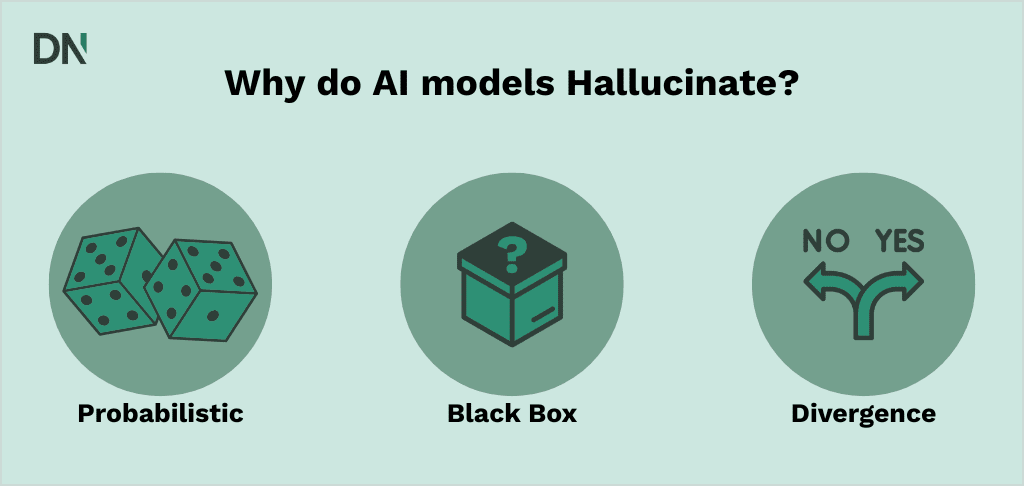
1. Probabilistic next-token prediction
LLMs learn to predict the next token, or word fragment, from the preceding context. Their predictions reflect statistical relationships between words rather than a guarantee that a statement is true. When training data provides limited coverage of a niche subject, a model may favor fluent language over factual accuracy, assembling a plausible answer without a reliable factual basis.
2. The black box of ungrounded models
A standalone foundation model, such as a standard GPT-4 or Claude 3 instance, relies on information encoded in its learned weights. It cannot inherently query a live database or check a claim without tools designed for that purpose. Without this grounding, answers depend on compressed internal representations that may lose information.
3. Source-reference divergence
Conflicting training material is another source of hallucinations. Internet datasets contain errors, satire and contradictory accounts. Models absorb these inconsistencies and may combine fiction with fact because their representations do not provide a clear truth label for every claim.
Mitigation strategies: how to reduce AI hallucinations
Hallucinations cannot currently be eliminated entirely. The source describes technical frameworks for reducing them to levels acceptable for enterprise applications.
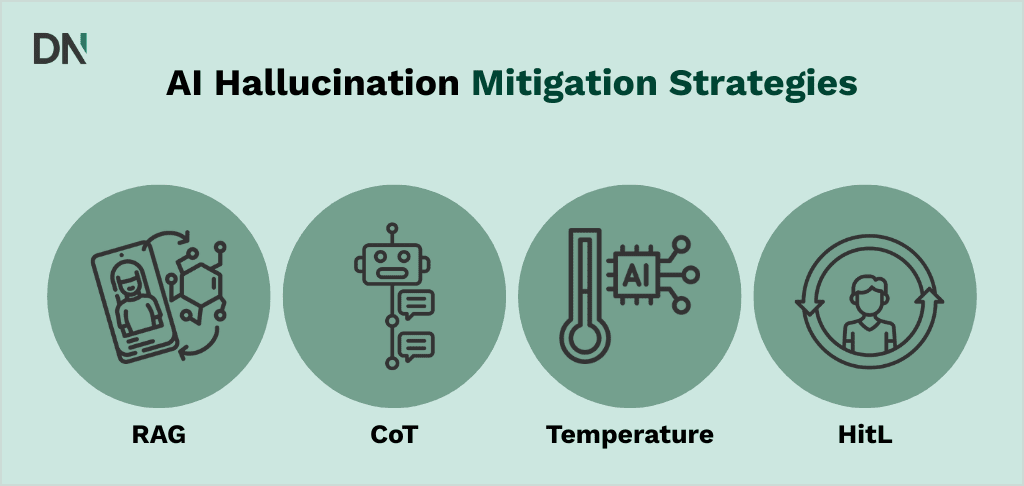
1. Retrieval-Augmented Generation (RAG)
The source identifies Retrieval-Augmented Generation (RAG) as the most effective technical approach to grounding AI.
A RAG system retrieves relevant documents from a trusted source, such as company PDFs, SQL databases or a knowledge base. It then supplies that information alongside the user’s question, reducing reliance on the model’s internal memory.
Instead of asking:
“Tell me about our company’s vacation policy.”
The instruction becomes:
“Using ONLY the following context retrieved from the HR Handbook [insert text], answer the question: ‘Tell me about our company’s vacation policy.'”
Research cited in the source reports accuracy improving from approximately 66% to 79% with RAG compared with standard LLMs.
- Implementation: secure pipelines connecting models to proprietary data typically require specialized generative AI development.
2. Chain-of-Thought (CoT) prompting
Chain-of-Thought is a prompt engineering technique that asks a model to explain intermediate reasoning before giving its final answer.
The source describes this as a way to reduce logical leaps and fabrication. It cites evaluations showing reduced hallucination frequency, while emphasizing that the reasoning must still be monitored for errors.
3. Adjusting temperature parameters
When using APIs such as OpenAI, Azure or Vertex AI, developers may have access to a temperature setting. The source describes these ranges:
- High temperature, 0.7–1.0: increases randomness and creativity, with a higher hallucination risk.
- Low temperature, 0.0–0.3: favors the most probable next token, described in the source as deterministic selection.
For factual tasks such as data extraction and financial analysis, the source recommends a near-zero temperature as a mandatory best practice.
4. Human-in-the-Loop (HITL) verification
High-stakes workflows, including legal drafting and medical summarization, require more than technical controls. Human-in-the-Loop processes place a qualified expert between the generated draft and its final use.
This is often part of AI change management, helping employees treat AI as a drafting tool rather than an independent decision-maker.
Which AI model hallucinates the least?
Models perform differently. The Vectara Hallucination Leaderboard measures hallucinations in document summaries, while Google also provides the FACTS leaderboard.
Model selection should reflect the intended use case. The following comparison preserves the figures in the December 2025 source.
| Model | Hallucination rate | Factual consistency rate | Answer rate | Average summary length (words) | |
|---|---|---|---|---|---|
| 1 | Gemini 2.5 Flash Lite | 3.3 % | 96.7 % | 99.5 % | 95.7 |
| 2 | Llama 3.3 Instruct Turbo | 4.1 % | 95.9 % | 99.5 % | 64.6 |
| 3 | Mistral Large | 4.5 % | 95.5 % | 99.9 % | 85 |
| 4 | Mistral Small | 5.1 % | 94.9 % | 97.9 % | 98.8 |
| 5 | DeepSeek V3.2 | 5.3 % | 94.7 % | 96.6 % | 64.6 |
| 6 | DeepSeek V3.1 | 5.5 % | 94.5 % | 94.5 % | 63.7 |
| 7 | GPT 4.1 | 5.6 % | 94.4 % | 99.9 % | 91.7 |
| 8 | Grok 3 | 5.8 % | 94.2 % | 93.0 % | 95.9 |
| 9 | DeepSeek V3 | 6.1 % | 93.9 % | 97.5 % | 81.7 |
| 10 | DeepSeek V3.2 | 6.3 % | 93.7 % | 92.6 % | 62 |
| 11 | Gemini 2.5 Pro | 7.0 % | 93.0 % | 99.1 % | 106.4 |
| 12 | Ministral 3b | 7.3 % | 92.7 % | 99.9 % | 167.9 |
| 13 | Ministral 8b | 7.4 % | 92.6 % | 99.9 % | 196 |
| 14 | Llama 4 Scout | 7.7 % | 92.3 % | 99.0 % | 137.3 |
| 15 | Gemini 2.5 Flash | 7.8 % | 92.2 % | 99.0 % | 101.5 |
| 16 | Llama 4 Maverick | 8.2 % | 91.8 % | 100.0 % | 106 |
| 17 | GPT 5.2 Low | 8.4 % | 91.6 % | 100.0 % | 126.5 |
| 18 | GPT 4o | 9.6 % | 90.4 % | 93.8 % | 86.6 |
| 19 | Claude Haiku |
Originally published by Jorick van Weelie at DataNorth
Comments
Join the discussionNo comments yet. Be the first to comment.