Context Engineering: What It Is and Why It Matters
Early discussions about generative AI focused on prompt engineering: finding the right wording to get a useful response. As organizations deploy AI more widely, context engineering has become equally important.
Prompt engineering shapes how you ask a question. Context engineering shapes the information available when the model answers. It organizes the material surrounding a large language model (LLM) to support accurate, relevant responses that fit business goals.
What is context engineering?
Context engineering means designing and managing the data, instructions and background information supplied within an AI model’s context window.
Unlike an employee familiar with your products, brand voice and customers, a general-purpose LLM does not automatically know your business. The source uses GPT-5.2 and Claude 4.5 as examples. Context engineering fills this gap through systems that supply relevant documents, data and previous interactions when needed.
The goal is to make a general reasoning model useful as a domain specialist without the cost and effort of building one from scratch.
The three layers of context
A context engineering strategy usually addresses three layers:
- System context: instructions defining the AI’s role, behavior and ethical boundaries. For example, a company’s support assistant might be instructed never to give financial advice.
- Retrieval context: current information drawn from sources such as PDFs and databases, often through Retrieval-Augmented Generation (RAG).
- Session context: conversation history that helps the model keep track of earlier exchanges.
This work changes the model’s inputs rather than retraining the model. It draws on data science, software development and an understanding of language.
Key aspects of context engineering
Effective context engineering combines data science, software architecture and linguistic strategy.
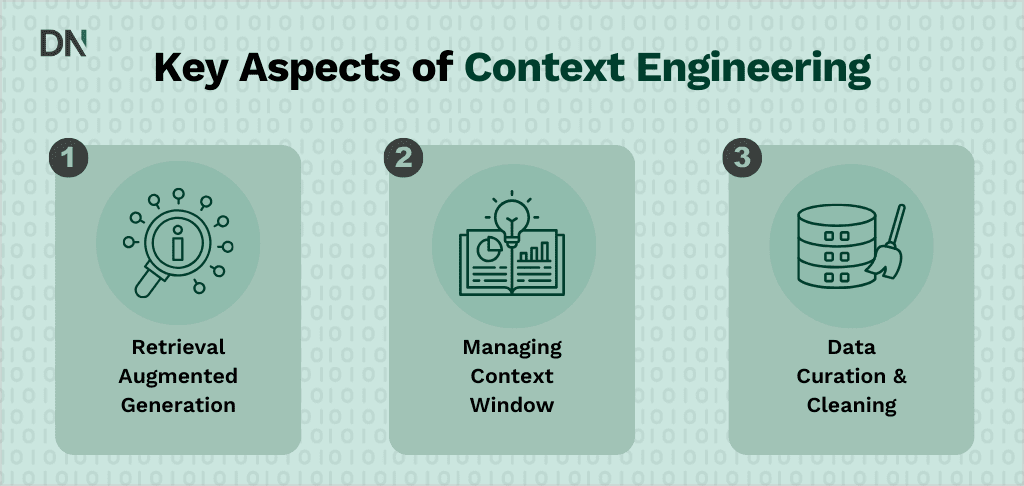
1. Retrieval-Augmented Generation (RAG)
RAG underpins many context engineering approaches by letting a model retrieve information before answering. A user’s question triggers a search of a vector database for relevant company documents. The system then adds those documents to the context window alongside the question.
Reliable retrieval requires specialized Generative AI development. If the retrieved information is irrelevant, the answer will suffer: garbage in, garbage out.
2. Managing the context window
Every LLM has a limit on how much text it can process at once, measured in tokens. Google’s Gemini 1.5 Pro illustrates the expansion of context windows to one million tokens, but filling a large window indiscriminately can cause problems.
Researchers describe a “Lost in the Middle” effect: models may overlook information buried within long inputs while paying more attention to the beginning and end. Context engineers organize material accordingly, placing critical instructions where the model is more likely to use them.
3. Data curation and cleaning
The work starts with data readiness, before any prompt reaches the model. Outdated PDFs and conflicting policies can lead to incorrect answers or AI hallucinations.
An AI feasibility assessment is often the first step in checking whether your data infrastructure can support context engineering.
Context engineering vs. prompt engineering
These disciplines serve different purposes. Prompt engineering refines instructions and is typically tactical and user-facing. Context engineering refines the surrounding information environment and is strategic and system-facing.
Think of an LLM as a capable university student taking an exam:
- Prompt engineering writes a clear, unambiguous exam question.
- Context engineering supplies the right textbooks, reference notes and calculator before the exam begins.
Comparison: prompt vs. context
| Feature | Prompt Engineering | Context Engineering |
|---|---|---|
| Primary focus | The phrasing of the query. | The data available to answer the query. |
| Scope | Single interaction (tactical). | Full system architecture (strategic). |
| Main goal | Elicit a specific style/format. | Ensure factual accuracy and grounding. |
| Scalability | Low (hard to manual prompt for every edge case). | High (automated data retrieval). |
| Required skills | Linguistics, logic, iteration. | Data engineering, vector search, API integration. |
A Prompt Engineering Workshop can improve individual productivity. A company-wide AI solution also needs an Artificial Intelligence Strategy that prioritizes context engineering.
Why context engineering matters
Context engineering helps turn an interesting demonstration into a dependable business tool.
1. Reducing hallucinations
Models may guess when they lack the information needed to answer. Supplying a specific fact, such as “The current price of Product X is €50,” grounds the response in relevant business data. This matters especially in industries with strict compliance requirements, where an AI Compliance audit may be needed.
2. Overcoming knowledge cutoffs
A model’s training knowledge reflects an earlier point in time. Context engineering supplies current information, such as stock prices, inventory levels or today’s news, so the model can work with facts that were unavailable during training.
3. Data security and privacy
A secure context pipeline can filter or anonymize information before it reaches the model, instead of relying on employees to paste sensitive material into a public tool. For particularly sensitive data, organizations may combine this approach with Local LLM consultancy to keep context processing on-premise.
Implementing context engineering
Building a system that manages context involves four steps:
- Vectorization: convert knowledge sources, including documents and wikis, into mathematical vectors.
- Storage: store that knowledge in vector databases such as Pinecone, Weaviate or Milvus.
- Orchestration: connect user input, the database and the LLM through workflows. Tools such as n8n can help; our n8n Workflow Automation Package supports these pipelines without heavy coding.
- Optimization: continually test which retrieved passages produce the best answers and adjust chunk size, or how much text is retrieved.
Conclusion
As AI models become commodities, competitive advantage increasingly depends on the context organizations provide. Context engineering connects a general-purpose model to the realities of a business, helping it become a precise, reliable enterprise tool.
For leaders moving beyond simple prompts toward robust systems informed by business data, engineering that context is the next step.
Frequently asked questions
What is the difference between RAG and context engineering?
RAG is one technique within context engineering. The broader discipline also covers system prompts, conversation history and strategies for optimizing token use.
Can context engineering fix a bad model?
To a degree. A smaller model such as Llama 3 8B can outperform a larger model such as GPT-4 when the smaller model receives excellent context and the larger one receives none. The model still needs enough reasoning ability to interpret the information it receives.
Does context engineering require coding?
Yes. Prompt engineering can happen in a chat interface, while context engineering involves data pipelines, API connections and retrieval logic. Building these systems typically requires machine learning development expertise.
Is context engineering expensive?
It can be. More context means more tokens, which can increase cost and latency. Effective context engineering balances sufficient information for accurate answers with concise inputs that keep costs under control.
Originally published by Jorick van Weelie at DataNorth on January 12, 2026.
Comments
Join the discussionNo comments yet. Be the first to comment.